Resealing a Grant of Probate in Malaysia: When a Foreign Grant Can Be Used and What Happens Next
Estate Administration

•
A Grant of Probate issued by a court in a Commonwealth country can, in an appropriate case, be resealed by the Malaysian High Court under section 52 of the Probate and Administration Act 1959 [Act 97]. Once sealed, the grant has the same force and effect in Malaysia as if the High Court had granted it, so the executor does not necessarily have to start a fresh Malaysian probate application.
Resealing is not automatic. It depends on which court issued the grant, where the deceased was domiciled at death and whether the grant is in the form the Court requires. It also does not, by itself, change the name on a Malaysian title or release a Malaysian bank account. For the wider picture of how probate and administration work here, see our ultimate guide to Letters of Administration and Grants of Probate.
This article covers the High Court route under Act 97 for Peninsular Malaysia. Sabah and Sarawak have their own probate legislation, and Muslim estates can raise additional issues.
Quick answer: can a foreign grant of probate be used in Malaysia?
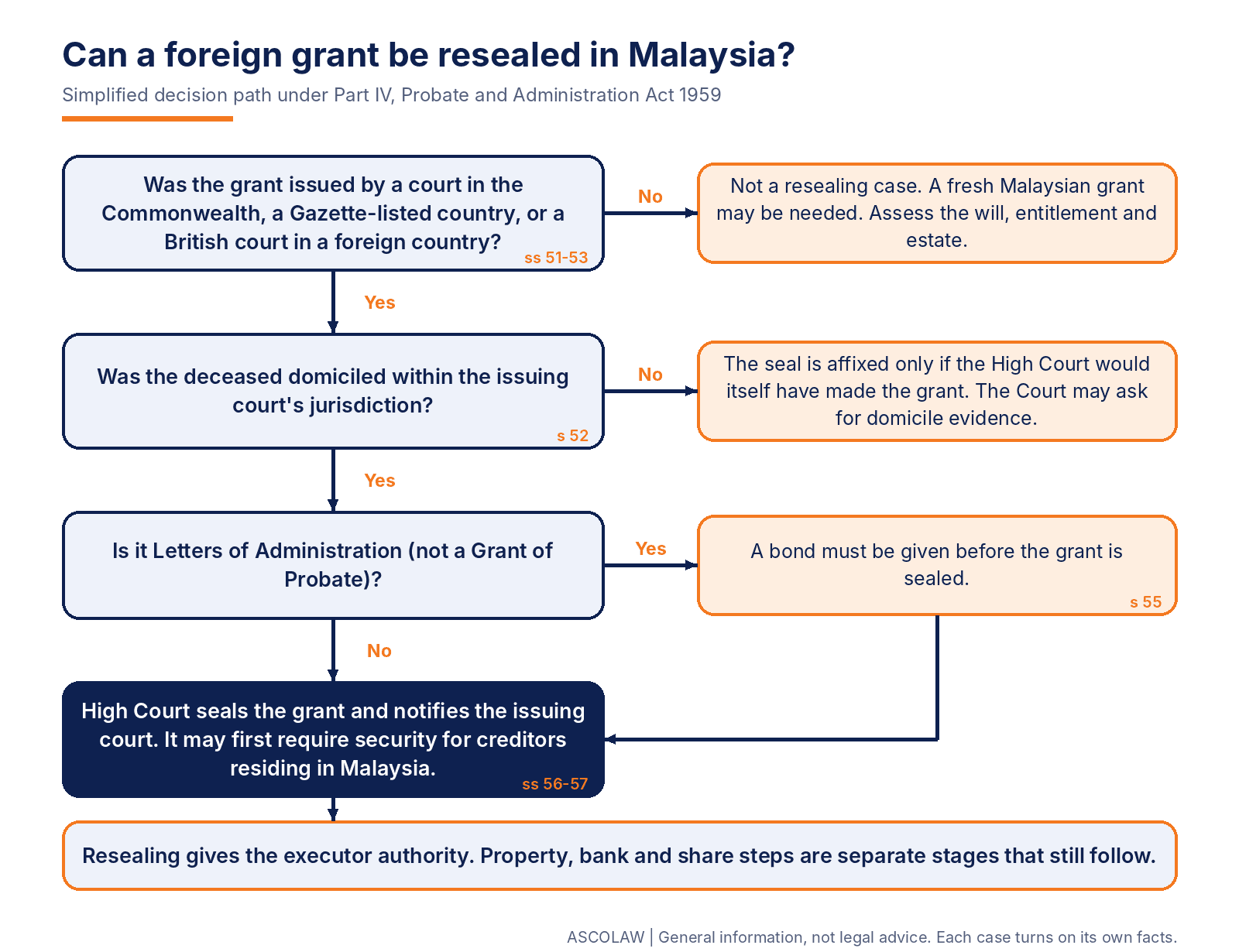
A foreign grant does not operate in Malaysia by itself. A qualifying grant has to be sealed by the Malaysian High Court under section 52.
A qualifying grant is one issued by a Court of Probate in the Commonwealth, in a country the Yang di-Pertuan Agong has added by Gazette notification (section 51), or by a British court in a foreign country (section 53).
If the deceased was not domiciled within the issuing court's jurisdiction, the seal is not affixed unless the grant is one the High Court would itself have made. The Court may ask for evidence of domicile.
Foreign Letters of Administration need security by bond before sealing (section 55).
For any resealed grant, the Court may require security for debts due to creditors residing in Malaysia if the deceased carried on business or resided in Malaysia within twelve months of death (section 56).
Resealing gives the executor authority. Property, bank and share steps still follow as separate stages.
If the grant cannot be resealed, a fresh Malaysian grant may be needed instead.
ASCOLAW's professional fees for resealing start from RM10,000, with the final quotation issued after we review the foreign grant and the Malaysian assets.
What does resealing a Grant of Probate mean?
A Grant of Probate is issued by a court to confirm the authority of an executor named in a deceased person's will. A grant obtained in another country does not automatically operate in Malaysia just because the same executor is dealing with the same estate.
Section 52 provides the mechanism. Where a Court of Probate in the Commonwealth has granted probate or letters of administration, the grant, or a certified copy sealed by the issuing court, may be produced to the Malaysian High Court and a copy deposited there. When the High Court seal is affixed, the grant takes effect in Malaysia as if it were a High Court grant.
That is the practical value of resealing. The executor may be able to build on the existing foreign authority to administer the Malaysian assets, instead of automatically making a completely fresh Malaysian application.
Which foreign grants can be resealed in Malaysia?
Resealing is not available merely because a foreign probate document exists. Four things need checking.
1. A grant must actually have been issued
Section 52 contemplates the grant itself, or a certified copy bearing the seal of the issuing court. A copy of the will or a private estate document is not enough.
2. The issuing jurisdiction must fall within Part IV
Section 52 applies to grants from a Court of Probate in the Commonwealth. Section 51 allows the Yang di-Pertuan Agong to extend "the Commonwealth" for this Part by Gazette notification, and section 53 separately covers grants made by a British court in a foreign country. Do not assume every foreign grant qualifies. Check the country and court against these provisions before the family commits to the process.
3. The deceased's domicile may matter
If it appears that the deceased was not domiciled, at the time of death, within the jurisdiction of the court that issued the grant, section 52 provides that the Malaysian seal is not affixed unless the grant is one the High Court would itself have made. The Court may also require evidence of domicile. Nationality, residence and domicile are different concepts, so the position should be established from the actual facts. This is a complication, not an automatic bar: the practical questions are why the foreign court issued the grant, where the deceased was domiciled at death and whether the Malaysian High Court can recognise the grant through this route. Assess them before filing.
4. There must be Malaysian assets to administer
Resealing becomes relevant where the deceased left assets in Malaysia that cannot practically be dealt with on the foreign grant alone, such as land or a house, a condominium or other strata property, bank accounts, shares and investments, or company interests.
Resealing or a fresh Malaysian grant: which route applies?
The table compares the two routes. It is a framework for the first conversation, not a decision rule, because the answer turns on the actual grant and the estate.
Question | Resealing a foreign grant | Fresh Malaysian grant |
|---|---|---|
Starting point | An existing grant of probate or letters of administration from a qualifying court (sections 51 to 53) | No foreign grant, or one that does not qualify for sealing |
Domicile | Checked under section 52. If the deceased was not domiciled in the issuing court's jurisdiction, the seal is affixed only if the High Court would have made that grant | The High Court assesses the application on its own requirements: the will, the applicant's entitlement and the estate |
Security | Letters of administration need a bond before sealing (section 55). The Court may separately require security for creditors residing in Malaysia (section 56) | Letters of administration generally require an administration bond (section 35) |
Role of the Court | The High Court decides whether the foreign grant should receive the seal. The Registrar notifies the issuing court (section 57) | The High Court decides whether to make the grant on the application |
Usually considered when | The executor already holds a qualifying foreign grant and Malaysian assets must be administered | There is no qualifying foreign grant, or the foreign grant cannot be sealed |
How does the resealing process work?
The papers depend on the foreign grant and the estate, but the work usually follows this sequence. After sealing, the executor moves on to the Malaysian assets themselves.
Step 1: Review the foreign grant
Check the type of grant, the issuing court and country, whether that jurisdiction falls within Part IV, who was appointed, whether the grant remains effective and whether domicile or the form of the grant needs to be addressed.
Step 2: Identify the Malaysian assets
Map what is registered in the deceased's name, which bank and investment accounts exist, whether any property is charged to a bank and whether there are known Malaysian debts. This shapes both the application and the work that remains afterwards.
Step 3: Obtain the proper foreign court documents
Section 52 contemplates the grant or a certified copy sealed by the issuing court. Documents not in English or Bahasa Malaysia may need translation.
Step 4: Prepare and file the High Court application
In Peninsular Malaysia, the application is made to the High Court by petition, supported by an affidavit and the estate documents. The Court may ask for more evidence if domicile or the status of the foreign grant is not adequately established.
Step 5: The Court decides whether to seal
Resealing is not a photocopy exercise. The Court keeps the statutory function of deciding whether the foreign grant receives the Malaysian seal. Two provisions are worth knowing:
Section 56: where the deceased carried on business or resided in Malaysia within twelve months of death, the Court may require adequate security for debts due to creditors residing in Malaysia before the grant is sealed.
Section 57: notice of the sealing is sent to the court that issued the foreign grant.
Procedure follows the Rules of Court 2012 (Order 71, non-contentious probate), and the exact forms are settled when the papers are prepared.
What documents should you prepare?
There is no universal checklist that fits every foreign estate. A solicitor assessing a resealing matter will commonly want to review:
the foreign Grant of Probate and the deceased's will;
the death certificate;
the executor's passport or identification document;
information showing the deceased's domicile;
documents showing the Malaysian assets, such as title details, bank, share or investment information;
known Malaysian liabilities and details of the beneficiaries;
translations, where required; and
any Power of Attorney proposed where the executor is acting from overseas.
The final filing requirements are settled only after the foreign grant and the estate have been reviewed.
What if the executor lives overseas?
An overseas executor does not necessarily have to travel to Malaysia for every step. If an attorney is to act for the foreign personal representative, however, the form and scope of the Power of Attorney, and who signs the petition, need proper attention. Settle them before filing and confirm them against the Court's current requirements rather than assuming.
What if the foreign grant cannot be resealed?
The Malaysian assets are not simply out of reach. A different route may be needed, such as a fresh Malaysian application for a Grant of Probate or Letters of Administration. The correct route depends on whether there is a valid will, who is entitled to act, the status of the foreign grant, the deceased's domicile and the nature and location of the assets. Where the named executor cannot act, our article on whether a beneficiary can replace the executor named in a will explains why the Court, not the family, decides who may take the grant.
Does resealing transfer a Malaysian property to the beneficiaries?
No. A resealed grant establishes the executor's recognised authority in Malaysia. It does not, by itself, change the name registered on a Malaysian title. Further land-administration and conveyancing steps may still be required before the property can be transmitted, transferred to a beneficiary or sold. Our guide to changing the name on a land and house title after a death sets out how that stage works. The same principle applies to bank accounts, shares and other assets: authority and asset-specific administration are related but separate stages.
What about foreign Letters of Administration?
Part IV applies to qualifying Letters of Administration as well as Grants of Probate, but the requirements are not identical. Section 55 requires the administrator or the attorney to give security by bond in the prescribed form before sealing. A family holding foreign Letters of Administration should have that route assessed on its own facts, and may find our guide to Letters of Administration in Malaysia useful for the local position.
How much does resealing a grant of probate cost in Malaysia?
ASCOLAW's professional fees for resealing a foreign grant start from RM10,000. The final quotation is issued only after we review the foreign grant and the Malaysian assets, because the work varies with the type of grant, the domicile position, the number and type of assets, whether the executor acts through an attorney and whether Letters of Administration with a bond are involved. The quotation sets out the professional fees and any disbursements and taxes. Reviewing the documents first avoids quoting on assumptions.
Is there a fixed timeline for resealing?
There is no single timeline that fits every case. It depends on how quickly the foreign documents can be obtained in the correct form, whether domicile evidence is straightforward, whether translations or further affidavits are needed, whether an overseas executor acts through an attorney and whether the Registry or Court raises further requirements. Reviewing the foreign grant and the Malaysian asset documents first is the sensible way to estimate the work.
Example: Singapore probate, Johor property
We have acted on a resealing matter where the deceased was Singaporean and left property in Johor. It is a common starting point: the Singapore court has already issued the Grant of Probate, so the question is no longer whether probate has been obtained. The questions become:
Does the Singapore grant fall within the Malaysian resealing provisions?
Is the grant available in the proper court-certified form?
Does the evidence establish the domicile position?
What Malaysian assets need to be administered?
What must be filed for the resealing?
After resealing, what property and banking steps remain?
What about assets in Sabah or Sarawak?
Check the Malaysian jurisdiction in which the estate procedure must be carried out. Sabah and Sarawak have their own probate and estate-administration legislation. If the deceased's Malaysian assets are located there, do not assume the Peninsular process described here applies unchanged. Confirm the jurisdiction and route before filing.
"Foreign probate does not close the Malaysian estate. It opens the next stage. Before anyone files anything, we read the grant, confirm the domicile position and map the Malaysian assets, because that decides whether resealing is the right route." - Akmal Saufi Mohamed Khaled, ASCOLAW
Frequently asked questions
Can a Singapore Grant of Probate be resealed in Malaysia?
Potentially. Singapore is part of the Commonwealth, so a Singapore grant can fall within section 52. The actual grant, the issuing court, the domicile position and the Malaysian estate still need to be reviewed before an application is prepared.
Can a UK or Australian Grant of Probate be resealed in Malaysia?
A qualifying grant from a Commonwealth Court of Probate may fall within section 52. Eligibility should be checked against the specific grant and circumstances, not assumed from the country name.
Do I have to prove the will again from the beginning?
Not necessarily. Resealing gives a qualifying existing grant effect in Malaysia. The Court can still require evidence relevant to the statutory requirements, including domicile.
Can I use the foreign grant directly at a Malaysian bank or Land Office?
Do not assume a foreign grant alone will be accepted as Malaysian probate authority. If the grant qualifies, resealing is the statutory mechanism that gives it the same force and effect as a High Court grant. The bank, registry or other asset holder may then have its own requirements before releasing or transferring the asset.
Is resealing the last step in the estate?
Usually not. Resealing establishes the executor's authority. The property, bank account, shares, liabilities and final distribution are dealt with separately afterwards.
Can I skip resealing and apply for a fresh Malaysian grant?
Where a qualifying foreign grant exists, resealing is the statutory route designed for it. Whether a fresh application is available or better depends on the will, the executor's position and the estate, so it should be assessed rather than assumed.
How much does it cost to reseal a grant of probate in Malaysia?
ASCOLAW's professional fees for resealing start from RM10,000. The final quotation is issued after we review the foreign grant and the Malaysian assets.
What should I send a lawyer first?
Start with the foreign Grant of Probate, the will and a list of the Malaysian assets, then add the other documents listed above. From these a solicitor can tell whether resealing appears available and what else is likely to be needed.
Key legal references
Probate and Administration Act 1959 [Act 97], Part IV (sections 51 to 58), section 35. A reference copy of the Act is available on CommonLII; check the current reprint before relying on it.
Rules of Court 2012, Order 71 (non-contentious probate).
Disclaimer: This article is for general information only and does not constitute legal advice. Cross-border estate administration depends on the foreign grant, domicile, jurisdiction, the Malaysian assets and current court requirements. Obtain specific advice from a licensed lawyer before acting.
Need us to assess whether your foreign grant can be resealed?
If an overseas Grant of Probate has already been issued and the deceased also left assets in Malaysia, submit the details through the enquiry form below and include the foreign Grant of Probate, the will, the death certificate, the executor's identification and a list of the Malaysian assets.
Those documents let ASCOLAW review the issuing jurisdiction and domicile, confirm whether resealing appears to be available and scope the Malaysian work before we advise and quote. Our Kuala Lumpur and Johor Bahru offices handle matters in person and online. You can also read about our Probet / Geran Probet service.
Related guides
Disclaimer
The content on this website is provided for general information and educational purposes only. It does not constitute legal advice and should not be relied upon as a substitute for a consultation with a qualified lawyer. Every legal matter is unique. You are strongly encouraged to obtain advice tailored to your circumstances from a licensed legal practitioner before taking any action based on the information provided here.
Although we strive to keep this content accurate and up to date, ASCOLAW and its affiliates make no representation or warranty, express or implied, regarding the completeness, accuracy, reliability, suitability or availability of the information on this website. Any reliance you place on that information is entirely at your own risk.
Author
AKMAL SAUFI MOHAMED KHALED
Managing Partner & Founder
Related Articles
Resealing a Grant of Probate in Malaysia: When a Foreign Grant Can Be Used and What Happens Next
Original Will Lost or Damaged: Can You Still Apply for Probate in Malaysia?
Grant of Probate Issued but the Estate Has Not Been Distributed: What Can a Beneficiary Do?
What Is a Grant of Probate in Malaysia? When Is It Needed and Who Can Apply?
Probate Lawyer in Malaysia: Scope, Documents, Costs and How to Get a Quotation
Executor Refuses, Dies or Cannot Act: What Happens to Probate in Malaysia?
Named as Executor in a Will: What Are Your Responsibilities After Death?
Named as a Beneficiary in a Will: What Are Your Rights After Death?
How to Apply for a Grant of Probate in Malaysia: Process, Documents and What Happens After the Grant
Can a Beneficiary Replace the Executor Named in a Will in Malaysia?