Process of JMB Collecting Outstanding Strata Maintenance Fees (FAQ)
Strata Management
Real Estate

•

All unit owners of strata property are obligated to pay maintenance charges which include service charge and sinking fund. Nevertheless, there is one main problem that always arises and that is the failure of a unit owner in maintenance charges payments. This is when you, as the Management Body steps in to recover the outstanding charges. This is according to the Strata Management Act 2013 and the Strata Management (Maintenance and Management) Regulations 2015 (“Regulations”).
Is this happening to you now? Well, this FAQ is prepared for you
In This Article
I have many parcel owners who don’t pay maintenance fees, what do I do?
What happens after the 14 days of Notice of Demand (NOD) issuance?
How much is a Notice of Demand (NOD) cost?
What is a Writ of Summons?
What are the type of documents that is required?
What if the parcel owner is not staying in the house?
How long does it take for a summons to be served?
What if after the judgement, the parcel owner still doesn’t pay?
What are the differences between going to the tribunal and court?
process of jmb collecting outstanding strata maintenance fees faq
Question:
I have many parcel owners who don’t pay maintenance fees, what do I do?
Answer:
Management Committee shall serve Form 20 provided under Regulation 31 of Strata Management (Maintenance and Management Regulations) 2015 to any parcel owners who default their payment for maintenance fees. If there is no payment within 14 days, please approach your solicitor and prepare the following documents (Latest Statement of Account that consists of the name of the owner and the last known address). Your solicitor will then prepare the Notice of Demand (NOD).
Question:
What happens after the 14 days of Notice of Demand (NOD) issuance?
Answer:
Your solicitor will then allocate 14 days to any parcel owner who intended to pay the outstanding amount. If there is no payment within the stipulated time frame, the Management Committee shall entitle to initiate legal action in court.
Question:
How much is a Notice of Demand (NOD) cost?
Answer:
Approximately RM30 to RM50 per NOD
process of jmb collecting outstanding strata maintenance fees faq
Question:
What is a Writ of Summons?
Answer:
Writ of Summons is one of the legal proceedings in court that enable the aggrieved party to claim their rights against the Defendant (defaulting party). The legal proceeding will be initiated either by way of Writ of Summons or Originating Summons. For this matter, the matter will be usually initiated by way of Writ of Summons. The writ will then be issued by the plaintiff, or the party suing, to the defendant. It requires the defendant to enter an appearance in court if the defendant wishes to defend the claim.
Question:
What are the type of documents that is required?
Answer:
Latest Statement of Account,
Identification Card Number of the parcel owners,
Last known address of the defaulting party.
Question:
What if the parcel owner is not staying in the house?
Answer:
It does not matter whether the parcel owner still resides in the residency or not. Any legal proceeding can still be commenced using any Defendant’s last known addresses. Your solicitor will then proceed with the filing of cause papers for serve by way of substitute service which will involve advertisement in newspaper etc.
(JPN search for now is not available for JMB due to unavailability of any binding documents or agreement etc)
Question:
How long does it take for a summons to be served?
Answer:
It shall take about 2 to 4 weeks for it to be considered as duly served on the Defendants. Once the sealed copy of Writ of Summon has been obtained, your solicitor will then proceed to serve the documents by way of AR Registered Post. The cause papers shall be deemed to have been duly served on the Defendant once the proof of service return.
Question:
What if after the judgement, the parcel owner still doesn’t pay?
Answer:
Issue Notice of Reminder. If there is no payment received within 14 days after the Judgement has been delivered to Defendant, the parcel owner may proceed with execution proceeding such as Judgement Debtor Summon, Writ of Seizure and Sale, Garnishee Proceeding or Bankruptcy Proceeding.
Question:
What are the differences between going to the tribunal and court?
Answer:
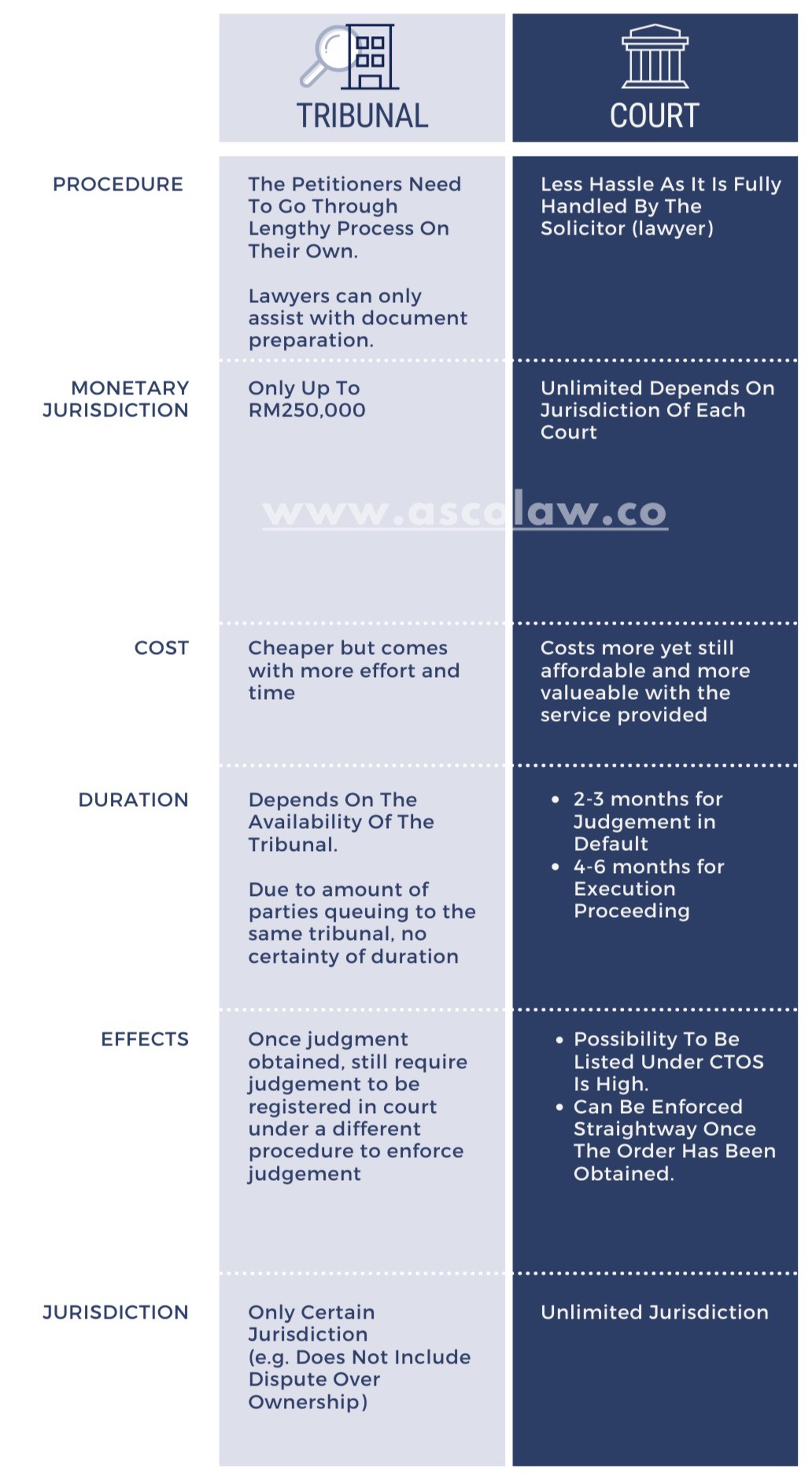
What are the differences between going to the tribunal and court?
process of jmb collecting outstanding strata maintenance fees faq
Disclaimer
The content on this website is provided for general information and educational purposes only. It does not constitute legal advice and should not be relied upon as a substitute for a consultation with a qualified lawyer. Every legal matter is unique. You are strongly encouraged to obtain advice tailored to your circumstances from a licensed legal practitioner before taking any action based on the information provided here.
Although we strive to keep this content accurate and up to date, ASCOLAW and its affiliates make no representation or warranty, express or implied, regarding the completeness, accuracy, reliability, suitability or availability of the information on this website. Any reliance you place on that information is entirely at your own risk.
Author
AKMAL SAUFI MOHAMED KHALED
Managing Partner & Founder


Related Articles
Resealing a Grant of Probate in Malaysia: When a Foreign Grant Can Be Used and What Happens Next
Official Land Search in Malaysia: What It Shows and Why It Matters
When Do Co-Owners of Land Need a Court Order in Malaysia? 5 Common Situations
What Is LPPSA? Meaning, Financing Types, Eligibility and the Lawyer's Role
Buying an Auction Property in Malaysia: What Bidders Need to Know
Estate Administrator in Malaysia: Duties, Liabilities and Limits of Power
Refinancing Your Home in Malaysia: How It Works, Pros and Cons, and When It Makes Sense
Building a House on Your Own Land in Malaysia: How to Appoint a Contractor
Refinancing a Home Loan in Malaysia: Legal Fees, Documents and Process
Selangor Land Office Interview for Property Deals of RM2 Million and Above: What Buyers and Sellers Should Expect