SPA vs LPPSA Documentation: What Is the Difference When Buying a Home?
Banking & Finance
Real Estate

•
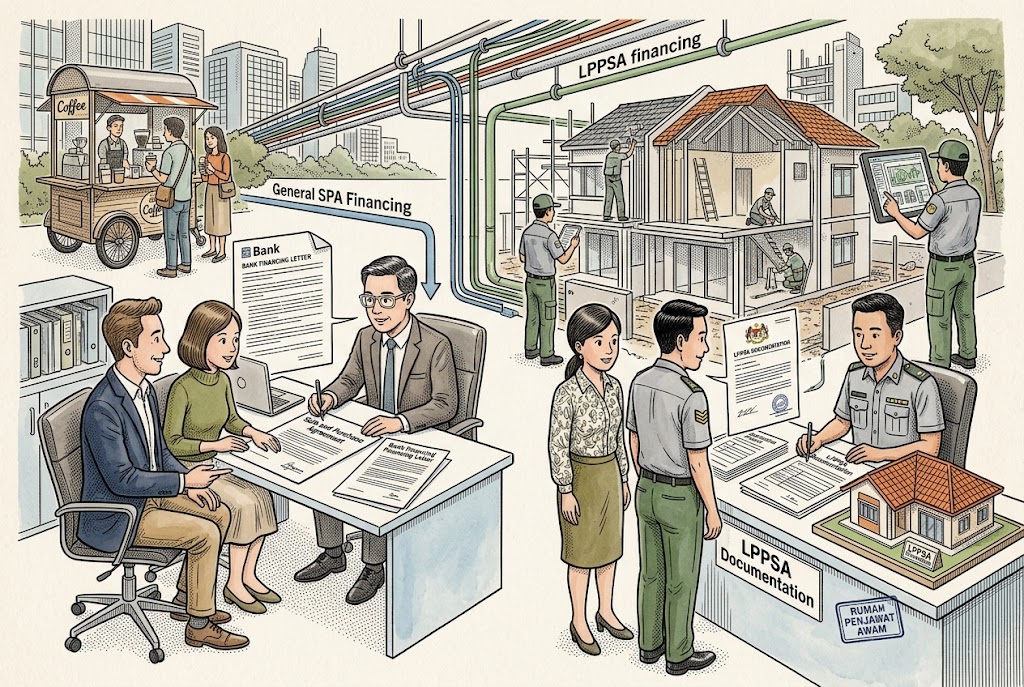
The SPA and the LPPSA documentation are not the same set of documents. The SPA (Sale and Purchase Agreement) governs the sale between you and the seller or developer. The LPPSA documentation records the financing, your obligations as a customer and the security that LPPSA (Lembaga Pembiayaan Perumahan Sektor Awam, the Public Sector Home Financing Board) requires under the relevant financing structure.
In a home purchase financed through LPPSA, the purchase documents and the financing documents move as two separate sets. Signing the SPA does not mean the financing can be released. Equally, LPPSA approval or signing the LPPSA documents does not replace your obligations to the seller under the SPA.
The difference matters because two timelines run at the same time. If the SPA requires the balance price to be paid by a certain date but the financing documentation has not yet met the release conditions, you may face late-payment interest or a default risk, depending on the SPA terms.
The short answer: the SPA answers "what is the buyer buying, and what have the buyer and seller promised each other?" The LPPSA documentation answers "how is LPPSA financing the purchase, what are the release conditions, and what security is given to LPPSA?"
"Clients often think that once the SPA is signed, everything is settled. In fact that is only one of two files. The LPPSA documents run separately, and the release conditions must be met before the money comes out," said Akmal Saufi Mohamed Khaled, lawyer and principal of ASCOLAW (Messrs Akmal Saufi & Co).
SPA and LPPSA documentation compared
Point of comparison | SPA | LPPSA documentation |
|---|---|---|
Main parties | Buyer and seller or developer | Applicant or customer and LPPSA as financier, plus any party giving security |
Purpose | Creates and governs the sale | Records the financing, the conditions for using the funds and LPPSA's security |
Focus | Property, price, deposit, conditions, completion, transfer, vacant possession and default | Financing amount, offer or approval letter, financing documents, charge or assignment, undertakings, release conditions and repayment |
If not complied with | Late interest, claims, termination or other remedies, depending on the contract | Release of financing can be delayed or not happen until the conditions are met |
When it ends | When the sale obligations under the SPA are fulfilled | The financing obligations continue for the whole financing period until settled and the security is released |
Both sets refer to the same home and the same price, but they create different legal relationships.
What the SPA does between buyer and seller
The main points an SPA usually sets out include:
the identity of the buyer and seller;
the property details;
the purchase price;
the deposit and how the balance price will be paid;
conditions precedent, such as consent to transfer where relevant;
the completion date and any extension;
redemption of the seller's existing financing;
the transfer or assignment;
the condition of the property and the items included;
delivery of vacant possession and keys;
apportionment of quit rent, assessment, charges and expenses; and
what happens if the buyer or seller fails to perform.
If you are using LPPSA, the SPA may state that part of the balance price will be paid through financing. But the seller is not responsible for guaranteeing that LPPSA will approve or release that amount.
What the LPPSA documentation does
After the financing is approved, the LPPSA documentation records the financing terms, the security documents and what must be satisfied before release. Depending on the financing type, the title status and the transaction structure, it can involve:
LPPSA's offer or approval letter;
a financing agreement, such as a Property Purchase Agreement for an Islamic structure or a Loan Agreement for a conventional structure;
security documents;
a registered charge, if the individual or strata title has been issued;
a deed of assignment, if the separate title has not yet been issued;
a power of attorney or other supporting documents;
the prescribed annexures and forms;
undertakings from the relevant parties or law firms;
proof that the difference money has been paid; and
documents for consent, stamping, registration or release.
LPPSA's official forms page publishes different document sets for Islamic and conventional financing. For example, the Islamic set lists a Property Purchase Agreement, a Property Sale Agreement and a Deed of Assignment, while the conventional set lists a Loan Agreement and a Deed of Assignment. The same page states that lawyers must not amend any form prepared by LPPSA and must use the forms uploaded on LPPSA's website.
Why the document names can be confusing
Words such as "purchase", "sale" or "agreement" in a title do not mean every document has the same function. An Islamic LPPSA financing set can include a "Property Purchase Agreement" and a "Property Sale Agreement", yet these are financing documents, not your SPA with the seller.
To tell them apart, look at:
who signs the document;
what its main obligations are;
what happens if it is breached; and
which other documents it refers to.
Do not sign based on the title alone. Ask your lawyer to explain the parties, purpose, obligations and link of each document.
Where the SPA and the LPPSA documentation meet
1. The property details must be consistent
The address, title number, lot, parcel, project name and owner details must match. A small difference can cause documents to be returned or need correction.
2. The purchase price and the financing amount are different figures
The SPA price is not necessarily the same as the LPPSA financing amount. If the financing is lower, you need to prepare the difference money. LPPSA's official FAQ states that the difference money must be settled by the borrower before the lawyer sends the Advice to Release (ATOR), the letter advising LPPSA to release the financing.
3. The SPA date is a reference point for the financing
The LPPSA documents may need the date and a copy of the SPA. Changes to the SPA after approval may need to be reassessed.
4. The title status decides the form of security
Where title has been issued, the security is usually a registered charge; where it has not, an assignment-based structure is used. For property in Peninsular Malaysia, transfers and registered charges are governed by the National Land Code; Sabah and Sarawak have separate land laws.
5. Completion depends on the release of funds
If you rely on LPPSA, most of the balance price can only be paid once the release conditions are met.
6. Undertakings connect the parties
The buyer's lawyer, the seller's lawyer, the developer, the seller's bank, LPPSA and others may need to give or receive documents and undertakings.
A simple example: one home, two sets of promises
Imagine a subsale home priced at RM500,000, and LPPSA approves financing of RM450,000.
Under the SPA:
you agree to buy at RM500,000;
the deposit and balance price must be paid by the agreed dates; and
the seller must complete the transfer and hand over possession as agreed.
Under the LPPSA documentation:
LPPSA provides a facility up to the approved amount;
you must sign the financing and security documents;
the release conditions must be met; and
you must repay the financing under the applicable terms.
The RM50,000 gap does not become LPPSA's responsibility just because the SPA price is RM500,000. You must prepare the difference according to the structure of the transaction.
What if the SPA is ready but the LPPSA documentation is not?
The practical risks include:
the completion date keeps running;
the difference money has not been prepared;
consent or searches are not complete;
security forms need to be corrected;
undertakings have not been received;
the release of funds is late; and
late interest or default action may arise under the SPA.
Approval alone does not mean every release condition has been met. Know the difference between "approved", "documents signed", "documents complete" and "funds ready for release".
What if LPPSA has approved but the SPA is not ready or has changed?
LPPSA approval does not by itself create a purchase. If the names of the parties, the price, the property or the transaction structure change, do not assume the original approval can be used without being checked.
What if the documents are signed but the money has not been released?
Signing is not the last step. Before release, there may still be:
stamping, or endorsement of any exemption;
consent to transfer or charge;
registration of the transfer and charge, or completion of the assignment;
release of documents by the seller's bank;
proof of the difference money;
updated searches;
undertakings;
delivery of original documents; and
compliance with specific conditions in the approval letter.
"Have the documents been signed?" is not enough. A more useful question is: "Which release conditions are still outstanding, who needs to resolve them, and what is the target date?"
Can one firm handle both the SPA and the LPPSA documentation?
One firm may be able to handle or coordinate both workstreams if it is appointed for both scopes and, for LPPSA customer financing documentation, it meets LPPSA's registered-lawyer requirements. LPPSA's Registered Lawyers portal states that registered LPPSA lawyers must subscribe to the Juris Credit module for any matter involving LPPSA customer financing documentation; a lawyer who does not will not appear in LPPSA's LMS system.
Since 1 January 2026, LPPSA housing financing is governed by Pekeliling Pembiayaan Perumahan LPPSA Bil. 1/2026, which replaced the 2025 circular.
Questions to ask your lawyer
Is the firm handling the SPA, the LPPSA documentation or both?
Who is the client for each scope?
What is the SPA completion date, and where are things now?
How much is the difference money, and when is it due?
Does the property use a charge or an assignment?
What consent, redemption or third-party documents are needed?
Which LPPSA release conditions are still outstanding?
Are the details in the SPA, the approval letter and the security documents consistent?
What do I need to do now?
What happens if one workstream is late?
How ASCOLAW can help
ASCOLAW, operated by Messrs Akmal Saufi & Co, can assess the purchase and financing scopes separately while keeping them connected, subject to conflict checks and acceptance of the matter. Messrs Akmal Saufi & Co is listed in LPPSA's Registered Lawyers directory. The work may include:
reviewing the booking form and SPA;
confirming the property details and title status;
reviewing the LPPSA approval letter;
preparing the applicable financing and security documentation;
coordinating consent, redemption, the difference money and undertakings;
tracking completion and the release conditions; and
handling registration or follow-up steps within scope.
Already have an SPA, a booking form or an LPPSA approval? If you want to know which set of documents is already in place, what is still outstanding and how the two workstreams should be coordinated, fill in the ASCOLAW enquiry form below.
Frequently asked questions
Is the SPA part of the LPPSA documentation?
No. The SPA is the contract between you and the seller or developer. LPPSA's documents may require a copy of the SPA and must match it, but they are a separate set that records the financing and LPPSA's security.
Why do I sign a "Property Purchase Agreement" when I already signed an SPA?
In an Islamic LPPSA financing structure, the Property Purchase Agreement and Property Sale Agreement are financing documents between you and LPPSA. They are not a second purchase contract with the seller.
Does signing the LPPSA documents mean the money will be released straight away?
No. Stamping or exemption endorsement, consent, registration or assignment, undertakings, the difference money and any specific approval conditions may still need to be satisfied before the lawyer can send the ATOR.
Can my lawyer change the wording of an LPPSA form?
No. LPPSA's forms page states that lawyers must not amend any form prepared by LPPSA and must use the versions uploaded on its website.
This article is general information only and is not legal advice for a particular transaction. The actual obligations of the buyer, seller and financier depend on the SPA, the approval letter, the LPPSA documents, the property's status and the facts of the transaction. References to the National Land Code relate to property in Peninsular Malaysia; Sabah and Sarawak have separate land laws.
Related guides
Disclaimer
The content on this website is provided for general information and educational purposes only. It does not constitute legal advice and should not be relied upon as a substitute for a consultation with a qualified lawyer. Every legal matter is unique. You are strongly encouraged to obtain advice tailored to your circumstances from a licensed legal practitioner before taking any action based on the information provided here.
Although we strive to keep this content accurate and up to date, ASCOLAW and its affiliates make no representation or warranty, express or implied, regarding the completeness, accuracy, reliability, suitability or availability of the information on this website. Any reliance you place on that information is entirely at your own risk.
Author
AKMAL SAUFI MOHAMED KHALED
Managing Partner & Founder

